Acceptance Rate Tuning
Introduction
Frequently when running simulations with the HMC the tuning the Molecular Dynamics (MD) parameters are non-trivial to tune.
In order to circumvent this issue hmcdj has a built-in
acceptance rate tuning functionality.
Built on the assumption that the user specifies the
trajectory length trajL, the code adapts the number
of molecular dynamics steps MDsteps.
Management of the acceptance rate takes place in three distinct phases:
- Thermalisation
- Tuning
- Production/Monitoring
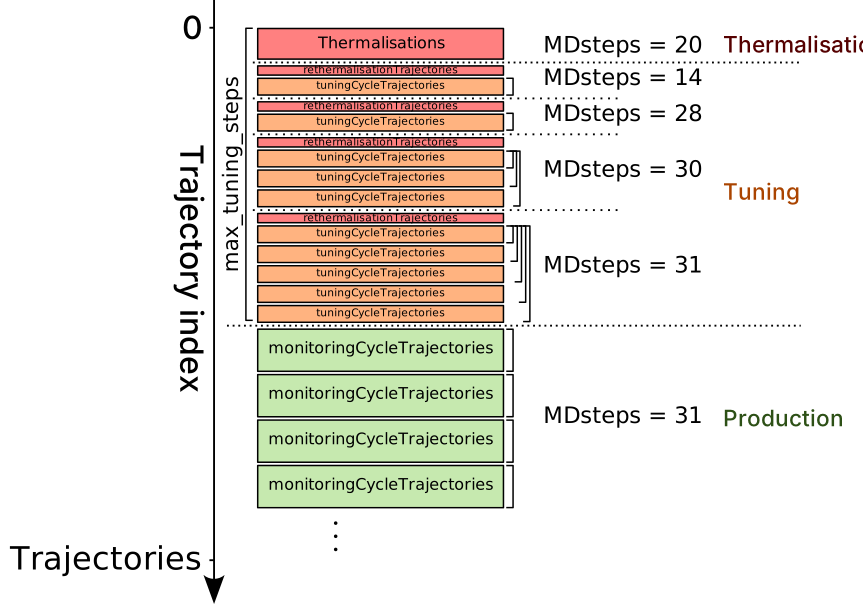
Initialisation phase
When the ensemble begins, a short period with no accept/reject
step takes place. Here the acceptance rate is not monitored.
The number of trajectories corresponding to this is given by the
Thermalisation in the track.
Tuning Phase
The acceptance rate is also not monitored for a short period after
the accept/reject step is activated,
and after any change to MDsteps.
This is to further thermalise the chain,
using the provided MDsteps in the track as the initial guess.
The number of trajectories in this period is given by rethermalisationTrajectories.
Following this, the HMC is run repeatedly for tuningCycleTrajectories
trajectories. The acceptance of each step is saved and then used to estimate
the acceptance rate.
If the acceptance rate is not within deltaTargetAcceptance of the
targetAcceptance then MDsteps will be tuned.
In order to find the optimal number of MDsteps, the
formula for the integration step
as a function of the acceptance rate is used:
Provided a target acceptance rate, MDsteps is
adjusted to obtain the desired step size.
This is implented by measuring the acceptance rate
and estimating the value of the constant \(\lambda\).
If the target acceptace rate is reached, the process will continue running without changing the MDsteps, and use the increased statistics to confirm more precisely that the acceptance rate is inside the desired interval.
This process is run for maxTuningTrajectories,
at which point hmcdj switches to monitoring the acceptance,
and reporting an error if it is outside the desired window.
Monitoring Phase
After the tuning has been completed,
hmcdj will monitor the acceptance rate in real time,
raising an error if it leaves the desired range.
Output file
hmcdj records the Metropolis result for each trajectory in
the file acceptance.xml in the ensemble directory.
This also stores a history of each change made to MDsteps,
so that it may go back and compute
the acceptance since the start of the most recent step.